Was it the Stars That Aligned—Or Our Wounds?
You meet someone and everything clicks. The chemistry is electric. The connection feels fated—like maybe the stars aligned just for you to find each other. But as the spark settles and real life begins, something else emerges: conflict, confusion, emotional whiplash. It leaves you wondering…
Was this destiny—or dysfunction?
Many of us are unconsciously drawn to people who carry similar emotional wounds to our own—but who express those wounds in opposite ways. These relationships feel magnetic and meaningful because they are—but not always for the reasons we first believe. They’re not written in the stars. They’re written in our nervous systems, our histories, and our unmet needs.
The Magnetism of Familiar Pain
There’s a reason some people feel instantly familiar: they echo the emotional environment you once adapted to. You might have learned early on that love required over-functioning, caretaking, or being invisible. So when you meet someone who mirrors that old rhythm, it feels like “home”—even when it’s painful.
For example, if you learned to cope with emotional neglect by becoming overly responsible and self-sufficient, you might be drawn to someone who copes with the same wound through emotional withdrawal and avoidance. You both fear emotional vulnerability—but your responses to that fear are inverse.
This pattern isn’t coincidence. As Dr. Harville Hendrix explains in Imago Relationship Therapy, we’re drawn to partners who reflect our childhood wounds—not because we enjoy pain, but because we unconsciously hope this time, we’ll finally get the love we needed.
When Wounds Dance in Opposite Directions
You and your partner may share a common core wound—such as feeling unseen, unworthy, or emotionally unsafe—but express it in contrasting ways. Here are some common patterns:
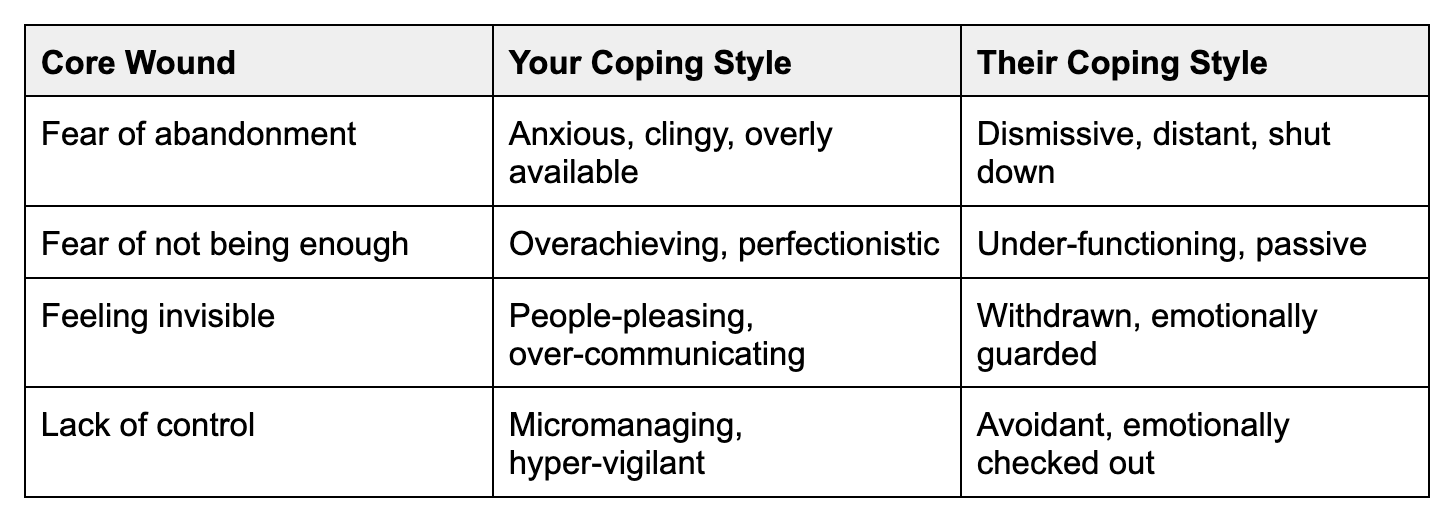
You both hurt. You both long to feel safe. But your survival strategies clash—creating a cycle of pursuing and withdrawing, fixing and avoiding, explaining and stonewalling.
Attachment Theory and Familiar Chaos
According to attachment theory, our early relationships with caregivers shape how we give and receive love. If those bonds were inconsistent, rejecting, or neglectful, we carry those experiences into adulthood.
Anxious attachers may seek closeness to soothe their fear of abandonment.
Avoidant attachers may withdraw to protect themselves from the pain of unmet needs.
When these two styles collide, it creates emotional tension that feels both deeply familiar and incredibly frustrating.
As trauma expert Dr. Gabor Maté puts it, “We are attracted to the familiar, not the healthy.” Until we become conscious of our own wounds, we’ll continue choosing partners who trigger them.
Was It Destiny—or an Invitation to Heal?
It’s easy to label these relationships as “toxic,” but they often serve a higher purpose: they mirror our unhealed parts. They reveal what we’ve learned to suppress, avoid, or fear. And if we let them, they can become sacred spaces for transformation.
Healing begins when we recognize:
We’re both doing our best to survive pain we didn’t choose.
We each have blind spots that block connection.
We don’t need to fix the other—we need to understand ourselves.
When we shift from blaming to curiosity, we reclaim power. We can ask:
What’s being activated in me right now?
Is this reaction about now—or about something older?
Can I show myself (and them) compassion instead of control?
Reflection Questions
What types of people are you repeatedly drawn to?
How do you typically respond to emotional discomfort in relationships?
Can you identify someone whose way of coping frustrates you—but might stem from a wound you also carry?
What would it look like to heal your own wound without trying to change theirs?
Final Thoughts
So, was it the stars that aligned—or your wounds?
Maybe both.
But if your relationship feels less like cosmic harmony and more like emotional tug-of-war, it may not be fate calling—it may be your inner child, asking for healing. The real alignment begins not in finding someone who completes you, but in becoming someone who sees and soothes your own pain. And from that place of wholeness, love begins to feel less like a battlefield—and more like a home.
If you’re beginning to wonder whether it was shared wounds—not just fate—that drew you into a relationship, you're not alone. Understanding the difference can bring clarity, compassion, and healing. If you're ready to explore the patterns beneath your connections, I invite you to reach out through my contact page. I'm here to walk with you.
References
Hendrix, Harville & Helen LaKelly Hunt. Getting the Love You Want.
Johnson, Sue. Hold Me Tight: Seven Conversations for a Lifetime of Love.
Maté, Gabor. The Myth of Normal.
Levine, Amir. Attached: The New Science of Adult Attachment.
